What Decision Changes?
A committee sits for ten hours.
Months of analysis have been distilled into a deck. Most of it survives perhaps ten minutes of discussion. Someone remarks that there is too much information.
Someone proposes a dashboard. By the following quarter, analysts are explaining the dashboard and engineers are tending to it like gardeners preserving a delicate species.
Everyone is busier.
The business is not obviously different.
Large organisations rarely suffer from a shortage of data. They suffer from having too many ways to avoid deciding.
The useful question is surprisingly plain:
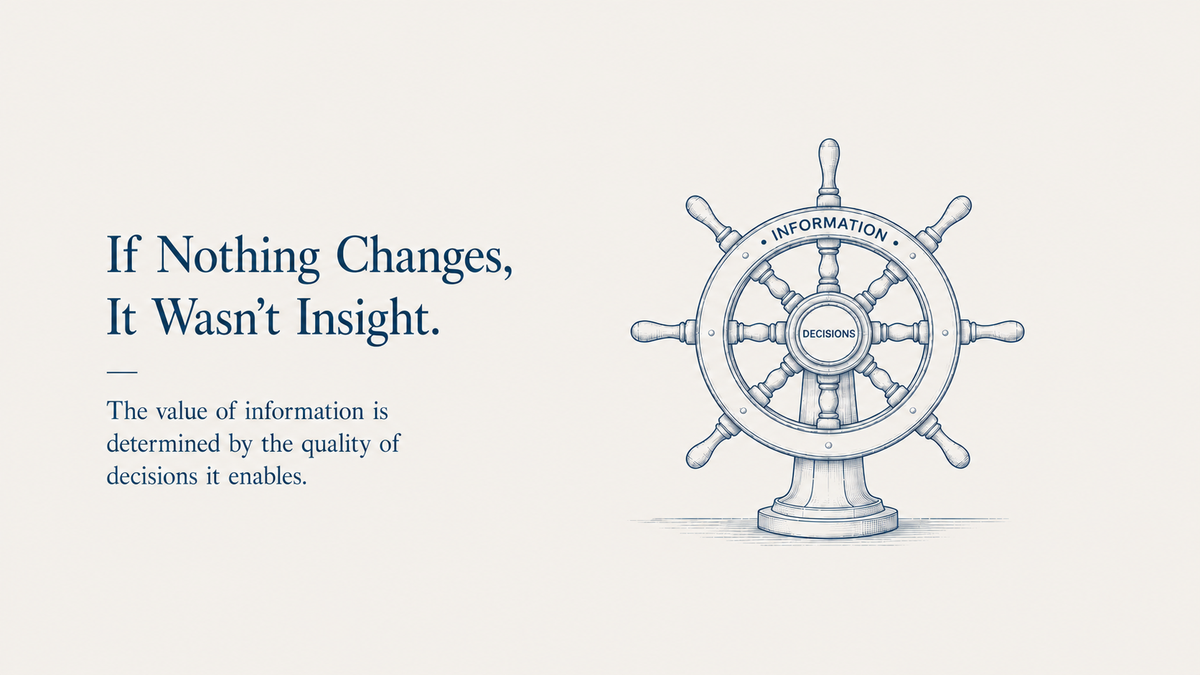
What decision becomes different if I know this?
If the answer is none, the information may be interesting, reassuring, or politically useful. It is not economically useful.
Institutions have a peculiar talent for mistaking accumulation for progress. They collect reports, metrics and dashboards the way anxious people keep receipts: proof that something happened, even if nothing changed.
Complexity, meanwhile, is stubborn. Compress a hundred measures into a single score and it does not disappear; it merely changes address, where another small bureaucracy waits to explain why the score moved by 0.3 points.
Imagine running the organisation as a plumber runs a van.
What must be known to win the next customer, earn the next dollar, and survive another year?