The Purpose of Strategy
Strategy is less about predicting the future than building an organization that learns faster than the future changes.
Most organizations mistake strategy for prediction. They assume the winner will be the one who sees the future most clearly.
History rarely belongs to those who wait for certainty.
It usually favours those who learn fastest.
The future has always been uncertain. What has changed is the cost of waiting. As technology compresses years into months and competitive advantages become shorter-lived, every month spent searching for certainty becomes more expensive.
In many situations, the cost of waiting now exceeds the cost of being wrong.
That changes the purpose of strategy.
It becomes less about making the right decision than reaching the next better decision sooner.
A decision is not the end of thinking. It is the beginning of it.
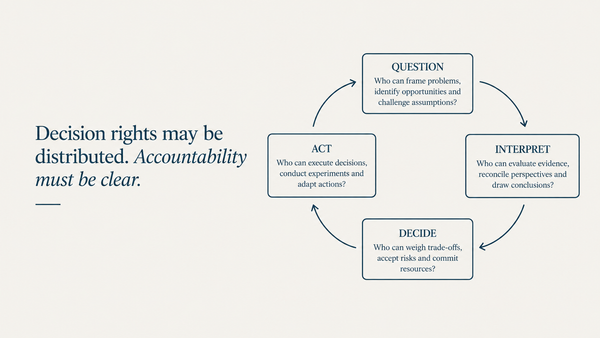
Every decision creates an experiment. Every experiment creates evidence. Every piece of evidence improves the next decision.
Action is how strategy learns.
Leaders are often expected to remove uncertainty.
They cannot.
Their job is to provide enough clarity that people can make good decisions without waiting for permission.
People do not need perfect forecasts. They need a direction that is clear enough to act on, and flexible enough to change.
Experiments unfold over weeks. Deliverables over quarters. Capabilities over years.
The challenge is not choosing one horizon.
It is connecting them.
The question is no longer What will happen?
It becomes What will still matter, whatever happens?
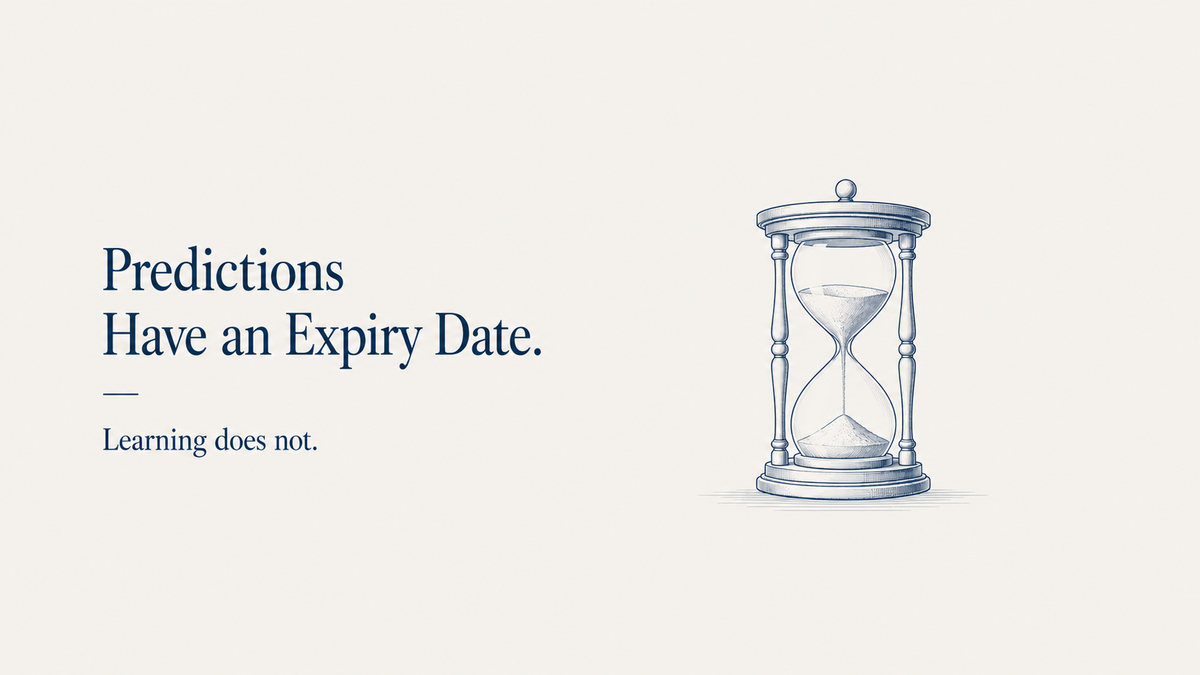
Predictions have an expiry date.
Learning does not.
We often believe better information creates better decisions.
More often, better decisions create better information.
In practice
When uncertainty increases, ask different questions.
What can we learn next?
Which decisions are reversible?
What capabilities will still matter, whatever happens?
In the end
Organizations rarely fall behind because they failed to predict the future.
They fall behind because they learned too slowly after it arrived.
The enduring advantage is not superior prediction.
It is building an organization that learns faster than the future changes.