The Trouble with Being Indispensable
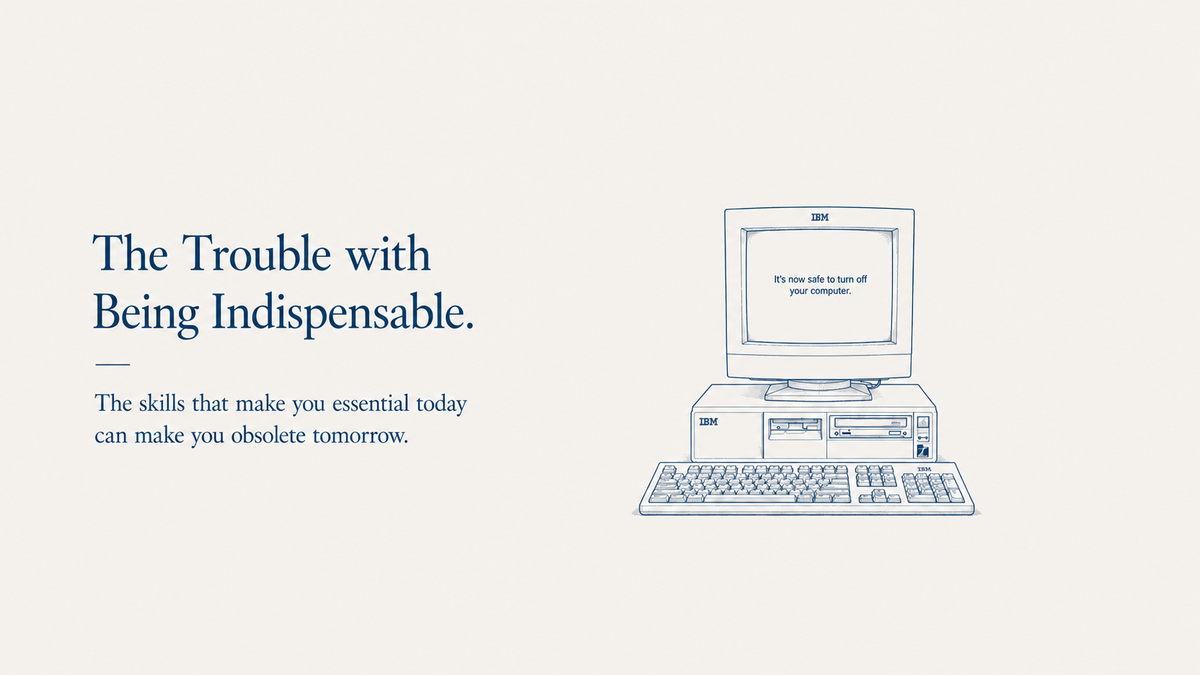
There comes a stage in almost every career when being difficult to replace feels rather like success.
You become the only person who understands the ageing database, the financial model with seventeen hidden tabs, or the VBA macro everyone else is slightly afraid to open. Before long, someone calls it mission critical. You begin to take the compliment for insurance.
It isn't.
It is simply a sign that too much of your value now depends upon one particular thing remaining important.
Every generation has its Microsoft Access. Once it was a respectable route to steady employment. Today it is little more than a museum exhibit with a login screen.
Technology becoming obsolete is hardly the interesting part. It has always done that.
What is remarkable is how readily we allow our sense of worth to become attached to something with an expiry date.
Expertise is immediately impressive. It has answers ready to hand. Meetings drift towards it. Calendars fill.
Adaptability rarely announces itself.
It usually looks like someone beginning again: reading outside their field, asking questions that sound faintly naïve, wandering into unfamiliar territory with no obvious concern for appearing knowledgeable.
For a while, the expert appears to be winning.
Twenty years later, one career has become a sequence of endings.
The other, a sequence of beginnings.
Knowledge has an awkward habit of dating itself. Rather like software screenshots. What once looked impossibly modern acquires, with surprising speed, the charm of an old catalogue.
Indispensability has a way of tying your future to yesterday's success.
History has never been especially willing to cooperate.
The people who remain useful are seldom those who cling longest to yesterday's expertise.
They are usually the ones who had already wandered off to learn something else.
The future, it turns out, has an odd affection for people who travel lightly.