Measure What Matters. Create What Lasts.

Why good judgement matters more than better data.
Organisations have never had more information about their performance. Dashboards multiply, forecasts become more sophisticated, and executives can explain last quarter in extraordinary detail. Yet one question is surprisingly difficult to answer: what has actually improved?
What we measure influences what we notice, reward and fund. A hospital can shorten waiting times without improving patient care. A school can raise examination scores without improving education. Both may meet their targets while missing their purpose. Measures shape behaviour, sometimes encouraging organisations to improve what is counted rather than what matters. The numbers are not necessarily wrong. They are simply incomplete.
Economist Amartya Sen offered a useful distinction: prosperity should be judged not merely by what people possess, but by what they are able to do. Income matters because of the opportunities it provides. Education matters because it expands choice. Progress, in this view, is ultimately about human capability rather than economic activity alone.
For leaders, the lesson is straightforward. Measurement should help improve outcomes, not simply describe performance. Every metric reveals something while leaving something else unseen. Choosing what to measure therefore requires judgement about what matters. A metric is valuable when it changes a decision, directs resources or exposes a problem worth solving. Otherwise, it may be little more than administrative work.
There is a cost to measuring everything. Each additional indicator requires analysis, discussion and management attention. A complicated dashboard may offer more information while making priorities less clear. The question is not how many metrics an organisation needs, but which ones help it make better decisions.
Precision deserves similar scrutiny. A financial model can calculate returns to three decimal places while depending on assumptions nobody can verify. In uncertain markets, a reasonable estimate tested quickly may be more useful than an elaborate forecast. Good leaders recognise what can be known, what must be assumed and what can only be discovered through experience.
This is particularly important in innovation. New technologies and markets rarely arrive with convincing historical evidence. The absence of precedent may signal risk, but it can also conceal opportunity. Data is indispensable for understanding established patterns; judgement is needed when those patterns begin to change.
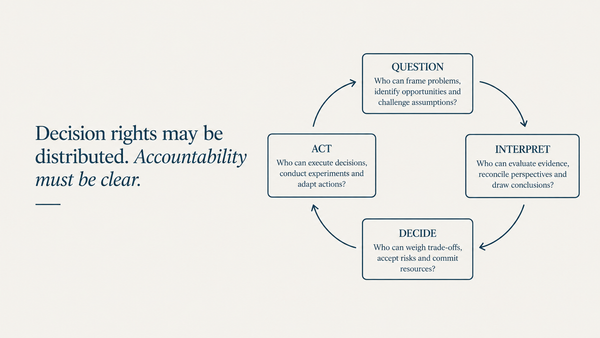
Judgement also improves with proximity. Customers and frontline employees often understand practical obstacles that never appear in management reports. A strategy is only as good as its performance outside the meeting room.
Resource allocation then becomes a question of leverage. Which intervention will deliver the greatest lasting benefit for its cost? Often, the answer lies in removing a constraint, improving an incentive or developing capabilities that enable people to make progress without continued assistance.
The distinction matters commercially. Costs can only be reduced so far. New products, markets and capabilities offer other ways to create value. A business can measure its existing performance perfectly while overlooking its next opportunity.
Four questions are worth keeping close: What are we trying to improve? Are we measuring the outcome or a convenient substitute? Where will our resources make the greatest difference? And will the benefits endure?
One practical test: if you removed 80% of your metrics tomorrow, would your decisions become worse, or simply faster?
The purpose of measurement is not to understand the future more precisely. It is to create a better one, sooner.