
The Architecture of Judgement
AI is making intelligence abundant. Competitive advantage may increasingly depend on who has the authority to question, interpret, decide and act.
Imagine a marketing director presenting an opportunity nobody had anticipated six months earlier.
Customers are behaving differently. New technologies make unfamiliar solutions possible. The evidence is incomplete, but something interesting is happening.
The CFO asks for financial projections. The numbers are uncertain. The opportunity is deferred.
Everyone has done their job.
And that may be precisely the problem.
Finance has evaluated the investment responsibly. Marketing has identified a possibility. Technology has established feasibility. Yet an opportunity requiring exploration has been judged by a process designed for validation.
Nobody lacked intelligence. The organisation lacked an effective way to combine it.
This matters because AI is changing the economics of intelligence.
Analysis that once required specialists can increasingly be produced in minutes. Forecasts become cheaper. Expertise becomes more accessible.
But making every department smarter does not necessarily make the enterprise wiser.
AI is decentralising intelligence, but decision rights are not necessarily following. More people can produce sophisticated analysis without gaining greater authority to influence what happens next.
Enterprise intelligence emerges not simply within functions, but between them—where different perspectives challenge assumptions and reveal possibilities no single function could recognise alone.
The scarce capability shifts from producing answers to determining which questions matter, whose interpretations count and who has the authority to act.
This is the architecture of judgement.
Every organisation distributes authority, deliberately or by historical accident. Some frame opportunities. Others interpret evidence. A smaller group commits resources. Still others execute decisions they had little influence over.
These arrangements determine not merely what an organisation can do, but what it is capable of seeing.
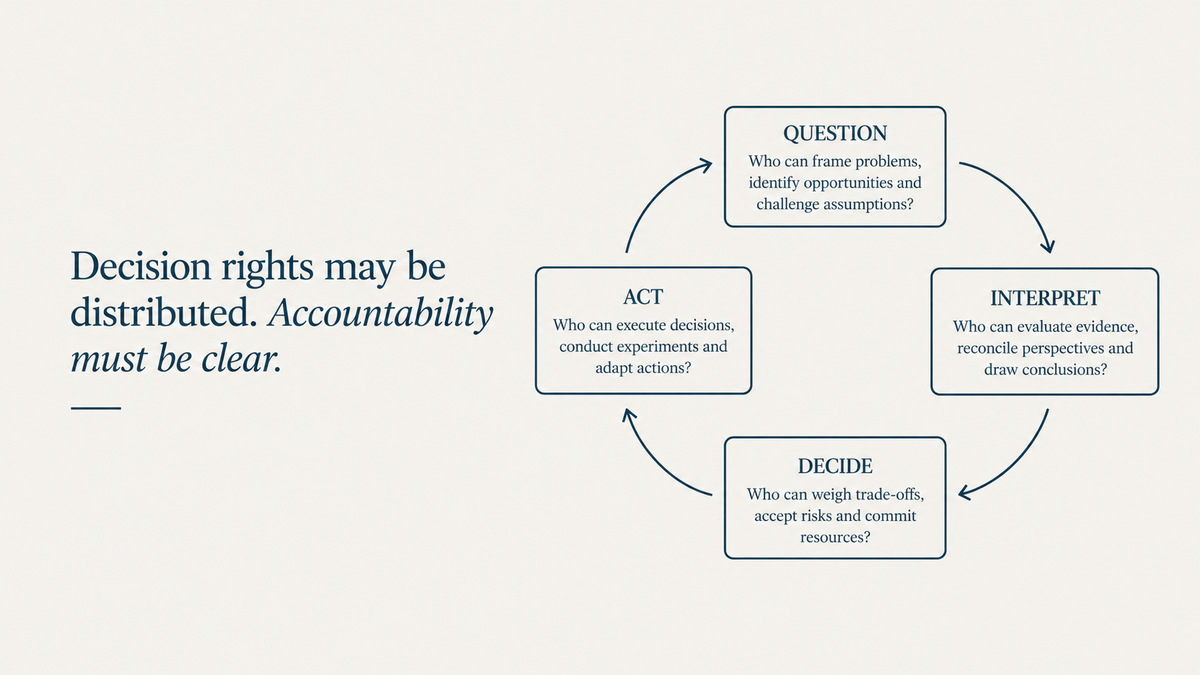
Four decision rights deserve attention.
The right to question. Who can define problems, identify opportunities and challenge assumptions?
The right to interpret. Whose expertise shapes the meaning of evidence when functions disagree?
The right to decide. Who can commit resources, accept uncertainty and make consequential trade-offs?
The right to act. Who can experiment, execute and learn within agreed boundaries?
These rights need not reside in the same function.
Judgement can be distributed. Final accountability cannot be ambiguous.
The authority to question and interpret can be broad. Each consequential decision, however, needs one designated owner with the mandate to make trade-offs and answer for the outcome, within clear governance boundaries.
Expertise in one domain does not automatically confer enterprise-wide authority. Finance understands economic constraints. Sales understands customers. Marketing senses emerging demand. Technology understands feasibility. None possesses the complete picture.
The authority to evaluate an opportunity should not automatically confer the authority to define it.
When those measuring outcomes also dominate the framing of opportunities, organisations risk optimising what they understand rather than discovering what they do not.
Automating existing workflows without examining decision rights may simply make flawed processes faster. AI is the catalyst, but the challenge of aligning expertise with authority is much older.
Consider your organisation's last major investment.
Who framed the opportunity? Who interpreted the evidence? Who challenged the assumptions? Who decided—and who was accountable?
Were these the right people, or simply those who had always held the authority?
When intelligence becomes abundant, competitive advantage depends increasingly on how organisations distribute judgement, assign authority and preserve accountability.