The Internal Tutor
There is a point in education when the problem changes.
At first, the difficulty is not knowing enough. Later, it is having more available knowledge than you can use.
Fifty things on the reading list. Several definitions of the same term. Three plausible arguments. Another lecture, another paper, another footnote.
And an essay due on Tuesday.
You begin with the innocent ambition of reading everything. By Monday evening, this has become mathematically implausible.
So you make choices.
Which three papers matter? Which disagreement is real? Which definition bears on the question? Is another hour in the library likely to improve the answer, or merely postpone having to write one?
At first, this feels like a defect in the system. Surely someone could simply tell you what matters.
But perhaps having to decide what matters is the education.
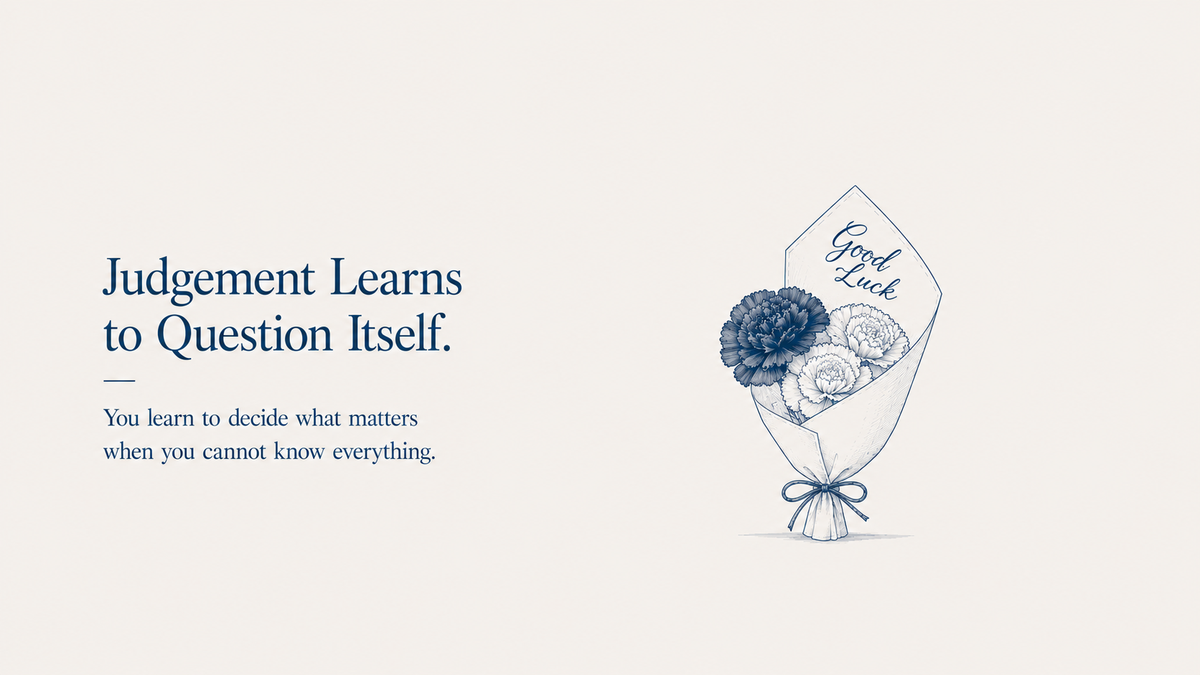
Judgement begins where complete information ends.
Knowledge is necessary. It is not sufficient.
There will always be something else you could know. Judgement is deciding what deserves your attention, what can safely be left alone, and when you know enough to act.
The pirate problem
Consider the slightly absurd problem of three pirates dividing some gold.
There appears to be an answer.
Then somebody asks why.
Suddenly the answer depends on things that were never stated. What happens if the proposal is rejected? What do the pirates value? Are they rational? Do they know the others are rational?
Change an assumption and the answer may change with it.
So the tutor is not merely interested in whether you found the accepted answer. The more revealing questions are underneath it.
What did you assume? What did you ignore? What would have to change for you to change your mind?
A conclusion tells us what you think.
The assumptions tell us why.
Good judgement knows what would make the answer different.
That is a more durable test of thought because circumstances change. The useful question is not only whether a conclusion is right today, but which parts of it would survive if the conditions moved tomorrow.
Finding the trunk
Reading presents the same problem in quieter form.
A novice sees fifty papers.
With experience, the fifty begin to resolve into a few important ideas, a handful of genuine disagreements and a great deal of elaboration.
Expertise is not knowing every leaf.
It is getting better at finding the trunk.
That includes knowing what not to read.
But how do you know what belongs to the trunk?
The question tells you.
Without a question, information cannot be relevant or irrelevant. It is simply information.
Relevant to what?
A student can read widely and still produce a poor essay because the reading has never been organised around a problem.
The temptation is to keep reading until an argument somehow appears.
A better process begins earlier with a provisional view.
What would have to be true for it to hold? What evidence could weaken it? Which parts of the literature bear directly on it?
Reading then becomes selective rather than exhaustive.
The point is not to know less.
It is to know what the knowledge is for.
There is always another source. More information can always be found. At some point, curiosity can cease to improve the decision and begin to postpone it.
Then comes a higher-order question:
Do I need to know more, or do I need to decide?
Why write before you are ready?
You rarely feel ready to write.
The argument is unfinished. There are gaps in the reading. Some thoughts remain contradictory.
But that is partly why writing matters.
A thought can remain impressively vague inside your head.
A sentence has fewer places to hide.
Once written, an idea can be inspected.
Does this follow? Do I believe it? Which assumption is doing the work here?
The imperfect essay is therefore not simply a record of thought. It is a way of discovering what the thought actually is.
Writing exposes the argument to yourself.
Then the tutorial exposes it to somebody else.
Another person encounters the argument.
They ask why.
The weakness becomes visible.
That is useful information.
The purpose is not to become someone who is never wrong. It is to become better at seeing why you might be wrong, what would change the conclusion, and what you need to learn next.
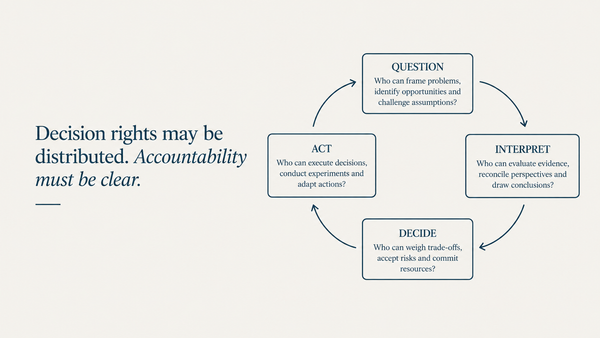
Freedom and accountability
There is something revealing about a system in which relatively little is compulsory but the tutorial is difficult to escape.
Much of the week belongs to the student.
Read this paper or that one. Attend the lecture or stay in the library. Follow one argument and abandon another.
The institution does not attempt to optimise every input.
But eventually you have to turn up and account for the output.
Freedom in how you get there. Accountability for what you bring back.
That is a rather sophisticated bargain.
A highly prescribed education can teach mastery very effectively. But if every input is specified, following instructions can take you a long way.
When there is more potentially useful material than anyone can consume, following instructions is no longer enough.
You have to discriminate.
What matters? What can be left out? Where is the uncertainty? Does it affect the conclusion?
Choosing the route is part of what is being learned.
The incompleteness that initially looks like a flaw may therefore be part of the mechanism.
We teach knowledge by giving people answers. We teach judgement by making them decide before all the answers are available.
The price of another hour
Deadlines make the same lesson harder to avoid.
Before the deadline, another hour of reading can feel harmless.
It is not.
That hour has displaced something else.
Eventually another paper is worth less than beginning the essay. Another improvement to the first answer is worth less than starting the second.
The deadline makes the trade-off visible.
This is why “done, not perfect” contains a more serious idea than it first appears to.
A decision has a cost. So does delaying one.
The difficult part is knowing when the expected value of more information has fallen below the value of acting on what you already know.
At that point, continuing to search is not necessarily intellectual seriousness.
Sometimes it is reluctance to decide.
The internal tutor
Perhaps the most durable part of this education is not any particular answer.
It is a small set of questions that gradually become habitual.
What is the question?
What am I assuming?
What actually matters?
What would change my mind?
Do I need more information, or am I avoiding the decision?
At first, someone across the table asks these questions.
Eventually, nobody needs to.
The tutor has become internal.
In practice
Begin with the question, not the available information.
Form a provisional view early enough to discover where it is weak.
Spend attention on uncertainties capable of changing the conclusion.
Write before you feel ready. Articulation exposes weaknesses that further reading can conceal.
Before seeking more information, ask whether it could change the decision or merely postpone it.
In the end
Education cannot prepare you for every problem by giving you every answer.
There will always be more to know.
The durable skill is deciding what matters before certainty arrives.
At first, the tutor asks the questions.
What are you assuming?
What would change your mind?
Do you need more information, or are you avoiding the decision?
Eventually, nobody needs to ask.
The tutor has become internal.
Perhaps that is how judgement is taught.
Not by removing uncertainty, but by learning what to do while it remains.