The Inheritance of Judgement
Great organisations don't scale experts. They scale the accumulated judgement of experts.
There is a small detail about Wagamama that explains more about the company than it first appears to.
The tables are numbered the same way in every restaurant.
A waiter arriving from another branch does not have to learn somebody else's private geography. He already understands the place.
It sounds trivial.
It isn't.
The same idea appears throughout the restaurant. New front-of-house staff learn the same sequence of service. They taste the food they will describe to customers. Presets are taught down to where the napkin goes. People learn different stations rather than guarding a single role. Mystery diners check that what was taught is what actually happens.
None of this requires exceptional talent.
That is precisely the point.
The organisation has already done part of the thinking.
Stored judgement
We usually think of judgement as something a person acquires.
An experienced waiter knows when to approach a table. Expertise grows through hundreds of small encounters, including plenty that went wrong.
But when the same situation keeps recurring, an organisation has a choice.
It can require every new employee to acquire the same experience.
Or it can capture what experience has already taught.
A service sequence is therefore more than a procedure.
It is stored judgement.
Someone once worked out what good looked like. The next employee gets to begin with the answer.
This is one of the quiet advantages of a well-run organisation: the next generation does not have to learn everything the previous generation learned the hard way.
Experience itself cannot be transferred.
Its lessons can.
Decide once
Most organisations respond to a judgement problem by trying to hire better people.
Better organisations train people well.
The best systems ask a different question:
Why are hundreds of people being asked to make the same decision?
If table numbering can be standardised, standardise it.
If people need to recommend the menu, let them eat the food.
If everyone needs to know how a table should be laid, show them exactly.
And if food is going cold because waiters protect their own sections, don't give a speech about teamwork.
Change the system.
At Wagamama, everyone runs food. Tips are pooled.
That small decision changes behaviour. With individual tips, helping another waiter may mean sacrificing your own income. With pooled tips, helping the restaurant helps you.
Good systems don't merely tell people what good behaviour is. They make good behaviour make sense.
That is more dependable than goodwill at 8:15 on a Saturday night.
Where judgement belongs
The aim is not to remove judgement.
It is to know where it belongs.
Some judgement can be captured. What table is this? When should I check back? What should opening look like? If the answer is repeatedly knowable, don't make hundreds of people rediscover it.
Some judgement can only be prepared for. The kitchen is late. A colleague hasn't arrived. Three tables sit down together. A customer is unhappy.
Here, context matters. Cross-training helps because the person who has stocked the bar understands what the bartender needs; the person who has run food understands why a dish cannot sit at the pass.
The routine is not a substitute for thought.
It gives people a foundation from which to think.
And then there are situations no sensible manual can anticipate.
When there was a fire at the Oxford branch, the normal service routines suddenly became irrelevant. Staff needed to be placed in other restaurants while the branch was rebuilt.
Doing that well required somebody who knew the people: where they lived, what their circumstances were, what would actually work for them.
The company could standardise table numbers.
It could not standardise whose life made which temporary branch workable after a fire.
That required human judgement.
And therein lies the paradox:
The more intelligently you standardise the known, the more intelligently you can decentralise the unknown.
When the capability belongs to the organisation
There is a simple test.
Take the person away.
If performance collapses when an experienced employee leaves, much of the capability still belongs to that employee.
If another trained person can step in and things continue to work, more of it belongs to the organisation.
This is why the waiter arriving from another Wagamama branch matters. Same service. Same table logic. Same operating language. Similar roles.
The new restaurant is already legible.
A capability has scaled when it survives the substitution of people.
Judgement has travelled further still when someone with limited experience can produce a good action without first acquiring all the experience from which that action was learned.
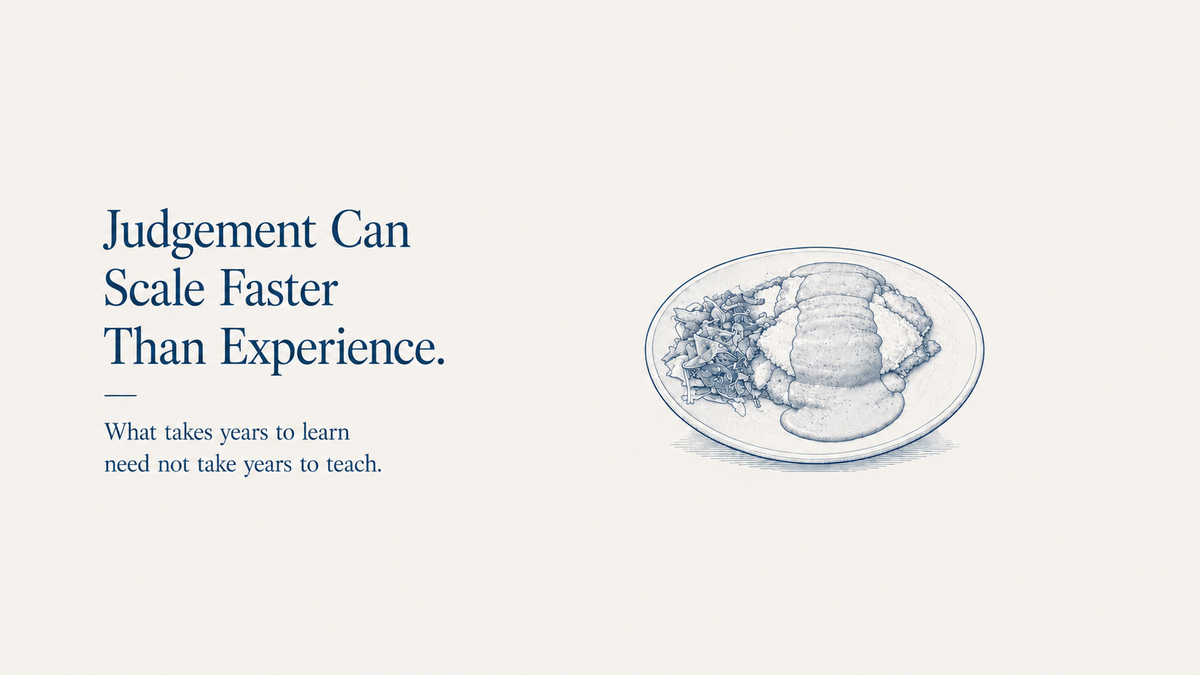
Twenty years of experience still takes twenty years.
Twenty years of lessons need not.
Wagamama took people who sometimes arrived with little experience or confidence and gave them a common way of working. They practised. They moved between roles. They learned the restaurant from different perspectives.
Some eventually taught others. Some became managers. People who arrived unsure of themselves went on to run restaurants. An 18-year-old recruit could grow into management. Others built careers lasting a decade or more in an industry known for rapid turnover.
What looks from the outside like a system for serving noodles is also a system for growing competence.
And eventually, the people produced by the system reproduce the system.
Where standardisation should stop
There is a danger in all this.
Once organisations discover that standardisation works, they are tempted to standardise everything.
That is where good systems become stupid ones.
A routine is useful when tomorrow resembles yesterday.
But reality eventually refuses to cooperate.
A fire. An unusual customer problem. A kitchen failure. An employee with circumstances nobody anticipated when the manual was written.
At that point, insisting on procedure is no longer discipline.
It is avoidance of thought.
So the real organisational skill is not standardisation.
It is knowing where standardisation should stop.
Capture yesterday's repeatable judgement without destroying the discretion needed for tomorrow's exceptions.
In practice
The questions for leaders are surprisingly simple.
What decisions are our people repeatedly making that should only need to be made once?
What important know-how would disappear if one of our best people left tomorrow?
Do our incentives reinforce the behaviour we teach?
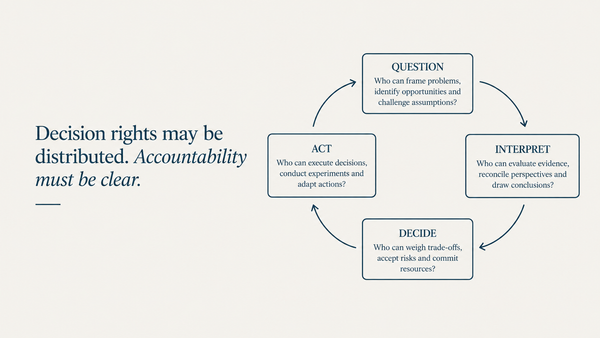
When something genuinely new happens, does authority move toward the person who knows the situation best?
The goal is not more procedure.
It is less unnecessary judgement and better necessary judgement.
In the end
Experience does not scale easily.
But its lessons can.
Every time an organisation turns a recurring judgement into a routine, a shared language, a training method or a well-designed incentive, knowledge moves from the individual into the institution.
That is why mundane details matter: the table numbers, the menu tasting, the presets, the shift huddle, the pooled tips.
They are not merely procedures.
They are stored judgement.
Great organisations don't scale experts.
They scale the accumulated judgement of experts.
They capture what is repeatable and preserve human discretion for what isn't.
So the interesting question is not simply how quickly an organisation can add people.
It is how quickly those people can inherit what the organisation has already learned.
Experience takes time. Its lessons don't have to.