The Discipline of Deviation
Creativity is not freedom from technique.
Watch an experienced teacher in a Sassoon cutting class.
The student has come to improve her craft, yet remarkably few decisions are hers. The model is chosen. The geometry is agreed. The hair is sectioned. Then, at the first irreversible moment, the teacher makes the opening cut.
Only then does the student begin.
She cuts a few sections. Stops. The teacher returns from another of the six chairs and notices things she cannot yet reliably see: tension, weight, overdirection, moisture, balance.
He corrects something. Explains why. Moves on.
The correction fixes the haircut.
More importantly, it teaches the student what to notice next time.
This is how technique becomes judgement.
Constraint has a purpose
We tend to imagine that autonomy develops by giving people freedom.
But a novice already faces a bewildering number of variables: length, geometry, tension, direction, weight, balance, texture. Asking her to decide everything at once does not necessarily produce creativity.
It produces more ways to be wrong without knowing why.
So the teacher fixes some variables. The geometry is established. The guide is set. There are stopping points.
This is not the removal of thought. It is the organisation of attention.
With some things held stable, the student can see what happens when something else changes. Cause and effect become easier to read.
This is why judgement develops through controlled variation, not repetition alone. The student encounters different versions of the same problem and gradually learns which differences matter.
The rule reduces uncertainty. But the lasting knowledge is not necessarily the rule itself.
It is the distinction the rule taught you to see.
The expert sees consequences
The novice sees hair.
The expert sees tension, weight, direction and balance—and what each is about to do.
A teacher saying look here, feel this tension, stand here rather than there is directing attention towards differences the learner does not yet recognise as consequential.
Eventually, those distinctions become her own.
Rules may be temporary. The perception they develop can become permanent.
Expertise is partly the accumulation of things that have become difficult not to notice.
And once you see those things, the rules begin to look different.
They are no longer merely instructions.
Not everything has the same status
During the cut, the teacher can be exacting. Geometry matters. Direction matters. Tension matters.
Later, the same student gives the finished haircut what she jokingly calls her “Louisiana blowdry”—more texture, more volume, distinctly hers.
The teacher lets her.
The lesson seems to have changed from do it this way to do it your way.
But that is not inconsistency. It is judgement.
Some things must remain because they protect the integrity of the result. Some can move within limits. Others are largely matters of preference.
And what belongs in each category changes with the situation.
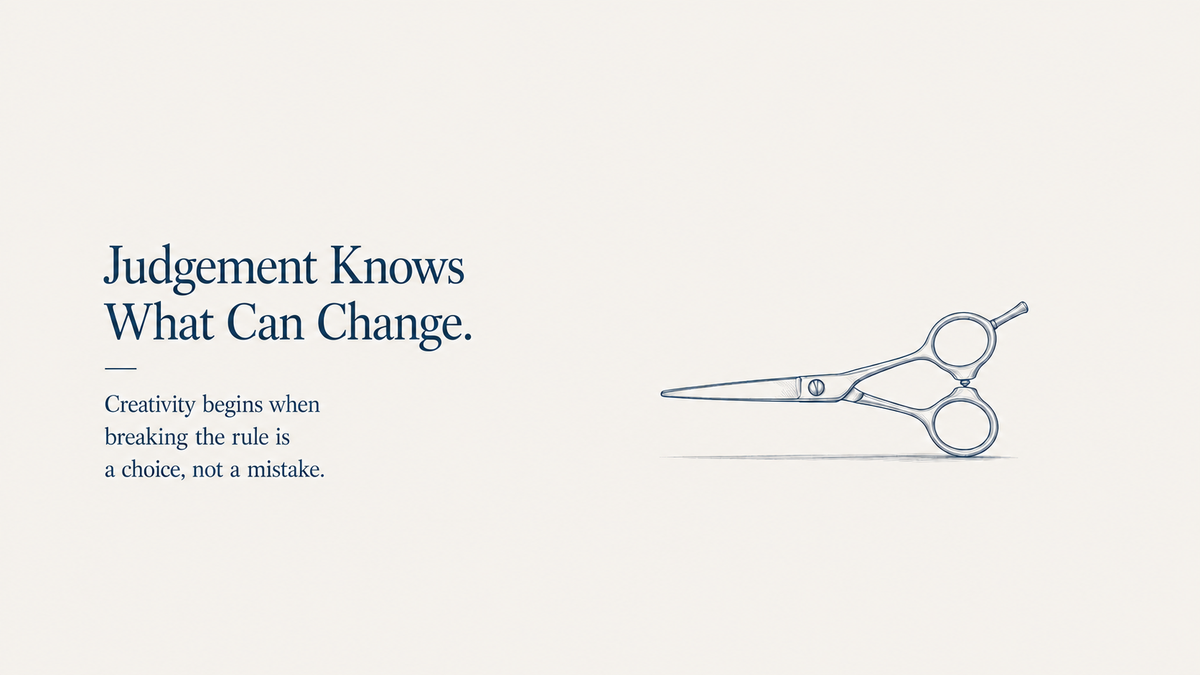
Judgement is knowing what must remain, what can change, and what will happen if it does.
This is why an experienced practitioner can soften an edge, alter a shape or introduce disconnection without abandoning the system.
The deeper knowledge is not this is the correct haircut.
It is these are the relationships that make the haircut cohere.
Once those relationships are understood, more than one execution becomes possible.
Learning to decide
There is another useful feature of the classroom.
One teacher moves among six students.
At first this looks like diluted tuition. But the interruption has an effect.
The student must act without the teacher continuously beside her. When he returns, reality has had a chance to answer. There is something to diagnose.
Meanwhile, five other haircuts provide variations on the same principles.
The student is not simply repeating a technique.
She is comparing cases.
Responsibility changes too.
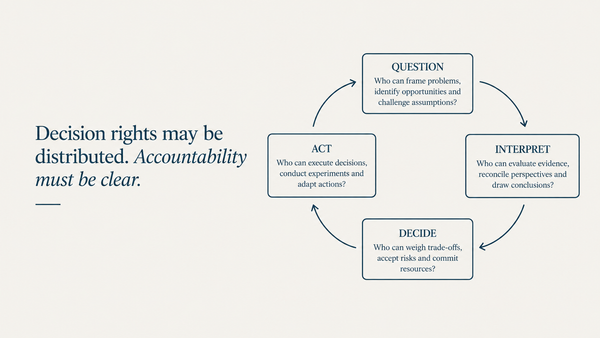
At first, the teacher makes the consequential decisions. Later, the student proposes. Eventually, she decides and the teacher diagnoses.
In professional life, the teacher disappears and the result itself provides the feedback.
What is being transferred is not simply work.
It is responsibility for increasingly consequential choices.
Autonomy is not doing more.
It is becoming capable of deciding more.
Where creativity begins
A novice can break a rule accidentally.
An expert can depart from the same rule deliberately.
The physical result may even look similar. The difference lies in what the practitioner understands about the consequences.
Could she predict what would have happened had she directed the section differently? Where would the weight have moved? What would have been gained? What would have been lost?
That is a stronger test of judgement than asking whether she can explain what she did.
Creativity requires knowledge of the alternatives not taken.
This is also why creativity is difficult to codify as a catalogue of creative moves. Prescribe all the acceptable deviations and you have simply written another rulebook.
What can be taught is more useful: how to make a legitimate departure.
Understand what must be preserved. Know what you are changing. Anticipate the consequence. Recognise when you have gone too far.
The rule has not been ignored.
It has been understood well enough to be bent.
That distinction travels far beyond hair.
In skilled work, fundamentals are not the enemy of originality. They make intentional departure possible.
In practice
When developing expertise, ask different questions.
What am I noticing now that I would not have noticed before?
What is this rule protecting?
What can change without damaging that?
If I change it, what do I expect to happen?
Could I predict what would happen if I chose differently?
In the end
The novice learns the rule.
The practitioner learns why it works.
The expert learns what it protects.
Once you understand what must be preserved, you are no longer confined to the original way of preserving it.
Technique gives you the boundary.
Judgement tells you which boundaries matter.
Creativity begins when you can change the method without losing what the method was protecting.