Politics Follows Territory. Progress Follows Purpose.
Adding capable people ought to accelerate progress.
Yet organisations frequently discover the reverse.
The first few hires add momentum. The next few create leverage. Then, almost imperceptibly, a growing proportion of effort is devoted not to the work itself but to explaining, coordinating, negotiating, and administering it.
Capability accumulates. Progress is under no obligation to keep pace.
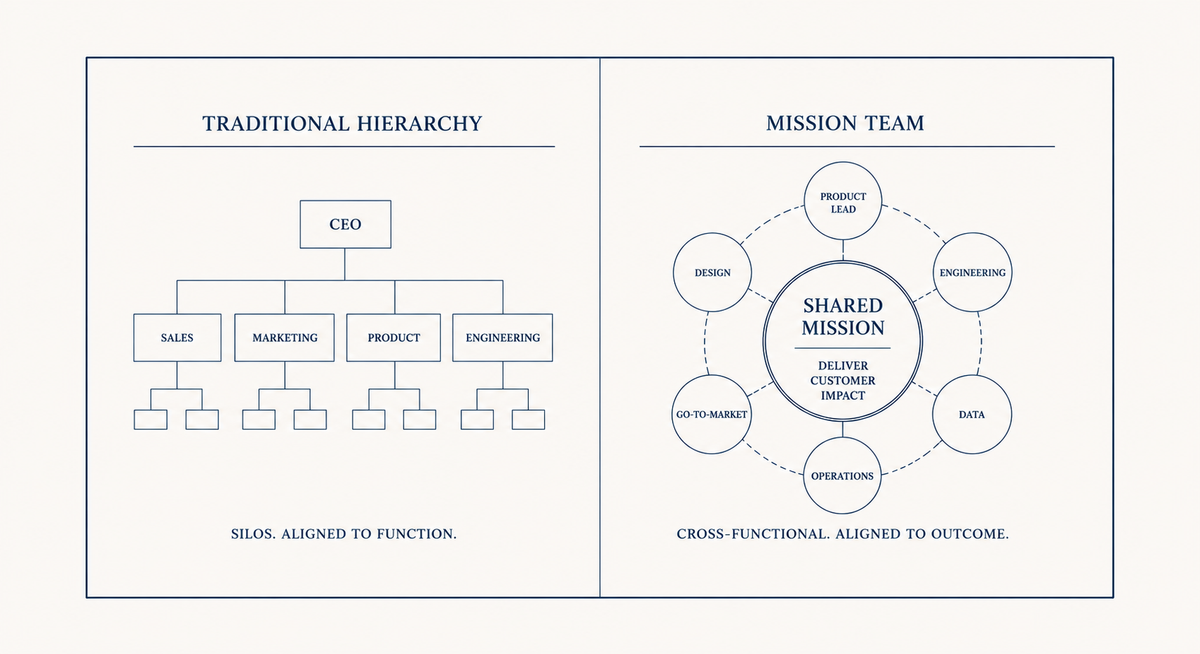
The institutions that endure do not answer complexity with ever more layers of supervision. Instead, they organise themselves around missions.
A mission brings together the people required to achieve a particular objective. Different skills, experiences, and disciplines are united by a common purpose. When that purpose has been fulfilled, the group dissolves or reassembles around the next challenge.
The power of such an arrangement lies not in its structure but in its concentration. Human beings are capable of remarkable achievements when moving in concert and remarkably little when their energies are dispersed.
Adaptability, then, is ultimately a matter of culture rather than process.
Institutions founded on trust, autonomy, and shared purpose are able to act with speed. Those defined by hierarchy and territorial ownership often find that politics expands more rapidly than progress.
Politics follows territory. Progress follows purpose.
Organisational charts describe authority. Missions direct attention. And attention, more often than authority, determines what gets done.