Learning to See
Before judgement can be practised, perception has to be trained. You cannot choose well among differences you cannot yet see.
Watch an apprentice tailor and something initially seems backwards.
The master makes nearly all the important decisions.
He chooses the garment. He marks the cloth. He decides where the buttonholes go. He bundles the thread and packs the buttons. He controls the order of work.
The apprentice gets a much smaller problem:
Make this stitch well.
Then make it again.
If the aim is independent judgement, this seems an odd way to begin. Surely people learn to make decisions by making decisions?
Eventually, yes. But first they have to learn what matters.
The master removes complexity so the apprentice can learn to see.
Consider a chalk mark.
To the apprentice it means: stitch here.
To the master it contains several judgements—about the cloth, the construction, what comes next and the result he is trying to achieve.
His thinking has been compressed into a white line.
The prepared trims, basting and pressing work in much the same way. They are not merely instructions. They are expert decisions made physical.
The workshop is full of the master’s judgement before the apprentice possesses it.
This may be the hidden work of apprenticeship: deciding which decisions the learner is not yet ready to make.
First, learn normal
The apprentice begins with ordinary garments.
Nothing unusually small, large, delicate or complicated. The same stitches. The same operations. Again and again.
Repetition establishes something essential: a baseline.
You cannot notice an exception until you have some feeling for normal.
After enough ordinary trousers, the apprentice knows how ordinary trousers behave—not as a written rule, but in the hand and eye. How the cloth should sit. How the finished work should look.
Then the master changes one thing.
A braid. An unusual pocket. A more difficult cloth.
Against everything that has stayed the same, the difference becomes easier to see.
This is how repetition becomes judgement. First you learn what normal feels like. Then you learn to notice departures from it.
Repetition alone can produce routine. Variation alone can produce noise. Judgement develops when a stable world is disturbed carefully enough for the learner to notice what changed—and what followed from it.
From instruction to intention
Over time, something subtler changes.
At first, the apprentice sees a chalk mark and thinks: stitch here.
Later, the same mark begins to say more.
Its position hints at the shape the master is trying to create. A crease suggests how he wants the cloth to fall. The amount of basting reveals where he expects difficulty. Even the trims packed with the garment anticipate what will happen next.
The apprentice is no longer simply following instructions.
They are beginning to read intention.
This is why basic technique must first become sufficiently automatic. When the thimble, needle, tension and sequence stop consuming all of your attention, you can notice higher-order things.
Soon the apprentice can anticipate what the master wants before being told.
Later, they understand why he wants it.
Eventually, they encounter other makers who want much the same result but achieve it differently.
That is where judgement becomes interesting.
It is no longer What am I supposed to do?
It becomes:
Of the several things I could do, which does this situation call for?
The library replaces the rulebook
There comes a point when one master’s workshop is no longer enough.
Other makers do things differently.
One prioritises durability. Another removes every possible bit of bulk. Someone has a better way of making a buttonhole. A garment made decades earlier—or in Italy rather than London—may contain the solution to a problem that has bothered you for years.
Here, the logic of learning reverses.
The novice learns by having variation removed. The expert learns by seeking variation out.
Early on, consistency makes differences visible. Later, difference enlarges the range of possible responses.
What accumulates is a library rather than a rulebook.
Rules are useful when reality resembles the rule. A library of experience helps you recognise what kind of situation you are actually in.
The mature maker therefore knows several good solutions, what each sacrifices and which trade-off matters now.
This is why an expert can examine another maker’s garment and sometimes reconstruct not merely what was done, but why.
Why was strength preferred to lightness? Why was bulk tolerated here but removed there? Why this sequence rather than another?
The work contains traces of the decisions behind it.
The experienced maker can read them.
What we call intuition
We often describe an expert as having an “eye”.
The experienced tailor has seen enough ordinary garments, exceptions, mistakes, corrections and alternative solutions that differences begin to announce themselves.
The novice sees a garment.
The expert sees what is unusual about it.
Years of experience have taught the expert which differences deserve attention.
This is why simply giving a novice more decisions is not necessarily empowering. A choice between possibilities that look identical teaches little.
The sequence matters.
Attention has to be narrowed enough for something to become visible. Normal has to become familiar enough for difference to stand out. Variation gives those differences meaning. Feedback attaches consequences to them.
Only then does greater responsibility become useful.
In practice
When developing someone’s judgement, don’t begin with:
What decisions should I let them make?
Begin with:
What must they learn to notice before this becomes a meaningful decision?
Then design the experience accordingly.
Reduce complexity. Make some decisions for the learner so their attention can be spent on what matters now.
Establish a baseline. Provide enough repetition for normal to become recognisable.
Introduce controlled variation. Change enough for the learner to perceive a difference, but not so much that everything becomes noise.
Make consequences visible. Connect what they noticed—or missed—to what happened next.
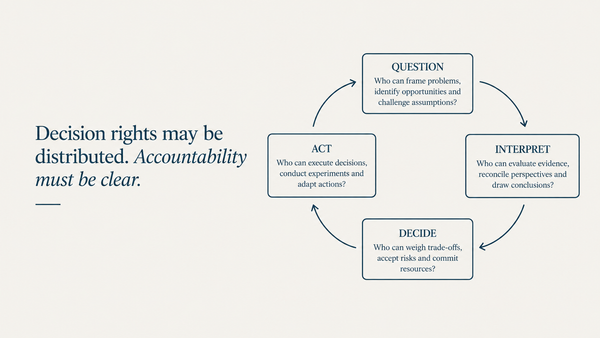
Return decisions progressively. Remove instructions as the learner becomes better at seeing the distinctions on which those decisions depend.
Expand the library. Once the fundamentals are stable, expose them to different experts, methods and trade-offs.
The teacher’s hidden work is not simply giving answers or letting people learn by doing.
It is sequencing experience.
In the end
Great teachers do something slightly paradoxical.
They take responsibility away before giving more of it.
They simplify before they complicate. They establish normal before introducing exceptions. They make their own judgement visible before asking the learner to exercise theirs.
Then they slowly disappear.
The apprentice does not become the master because they have memorised the master's answers.
They become capable because they have learned to notice what the master noticed.
Judgement isn't learned by practising decisions. It is learned by acquiring the perception that makes good decisions possible.
Perhaps that is what a master ultimately passes on.
Not his answers.
His way of seeing.