The Curious Case of Stale Data
We often talk about data as if it ages like food.
Fresh data is valuable.
Old data is stale.
But that analogy breaks down surprisingly quickly.
Nobody looks at fifty-year-old census records and calls them stale.
Economists routinely analyse data collected decades ago. In many cases, its value increases with age because patterns only become visible over time.
Yet in business, a contact record can be labelled stale after only a few years.
A contact leaves a company.
A prospect stops responding.
An email address goes quiet.
The assumption is that the data has lost its value.
But value depends on the question being asked.
A contact who no longer works at the company may be useless if the question is:
"Can we email this person today?"
The same contact may be invaluable if the question is:
"Which senior decision-makers have we built relationships with over the last decade?"
The data is unchanged.
Only the question is different.
Most organisations judge data according to the purpose for which it was originally collected.
The problem is that tomorrow rarely asks the same questions as today.
Which is why "stale data" is often the wrong phrase.
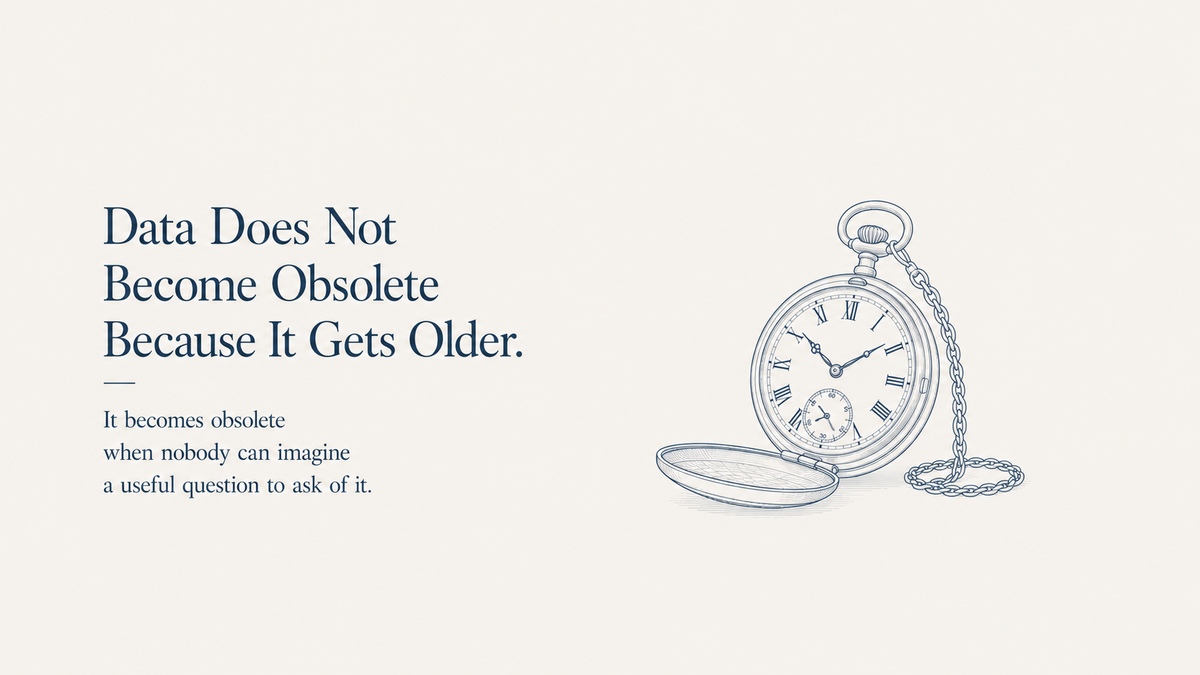
Data does not become obsolete because it gets older.
It becomes obsolete when nobody can imagine a useful question to ask of it.