The Cost of Learning Too Slowly
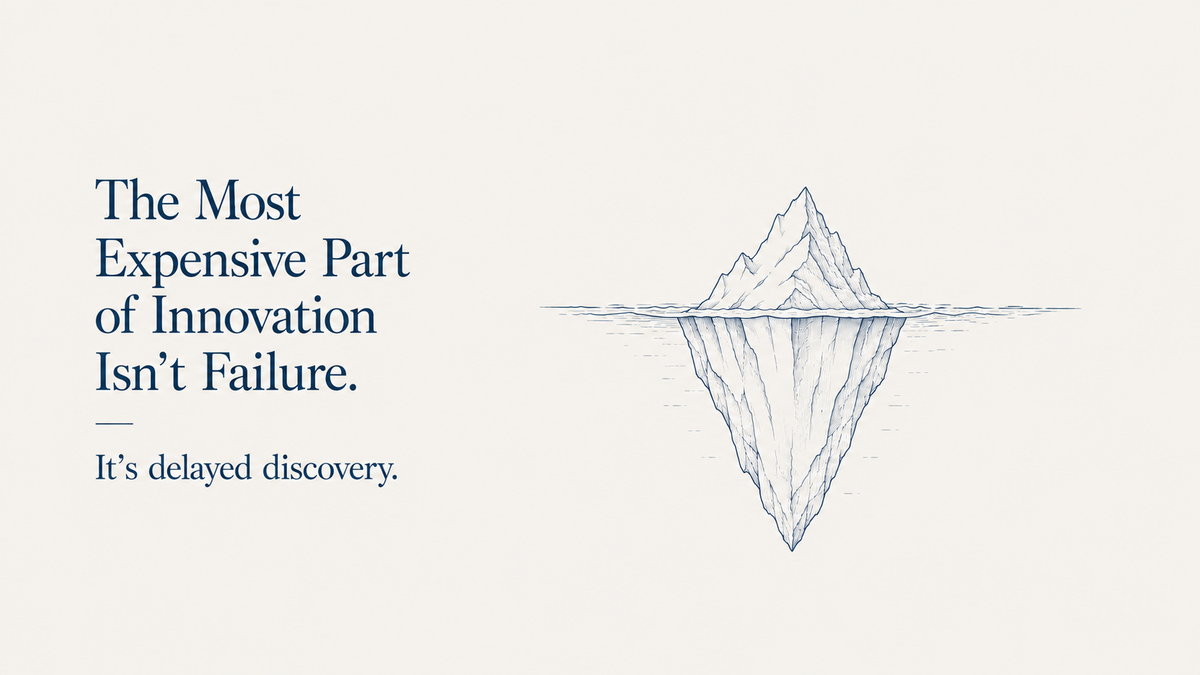
Imagine two companies making the same mistake.
The first discovers it after three weeks.
The second discovers it after three years.
The mistake is identical. Yet one survives and the other may not.
Why?
Because mistakes have a peculiar property. They grow while nobody is looking at them.
A product nobody wants accumulates engineering effort. A flawed strategy accumulates budget. A false assumption accumulates people, plans, meetings, and commitments. By the time reality finally arrives, the organization is no longer correcting a mistake. It is unwinding an investment.
This is why the most expensive part of innovation is often not failure.
It is delayed discovery.
Most organizations measure the cost of building. Few measure the cost of not knowing.
Yet every strategy, product, and technology decision begins with uncertainty. The critical question is not whether unknowns exist. They always do.
The question is how quickly they are exposed.
The goal is not to be right.
The goal is to discover what is wrong while the cost of being wrong is still low.
Competitive advantage comes from discovering reality before everyone else does.