If You Can Buy It, It Probably Isn't Your Advantage
Large organisations often treat data quality as though it were synonymous with data value.
Quality does not create value. It magnifies it.
Consider contact records, company information, or organisational hierarchies. If a vendor can sell you a cleaner version next Tuesday, its value is bounded by the price of a procurement contract. Better quality may improve efficiency; it rarely creates advantage.
The most valuable datasets are different. They emerge from a firm's relationships, decisions, and experience: how customers actually choose, who influences outcomes, where teams spend their time, and which patterns consistently precede success.
The mistake is not valuing quality. It is starting with it.
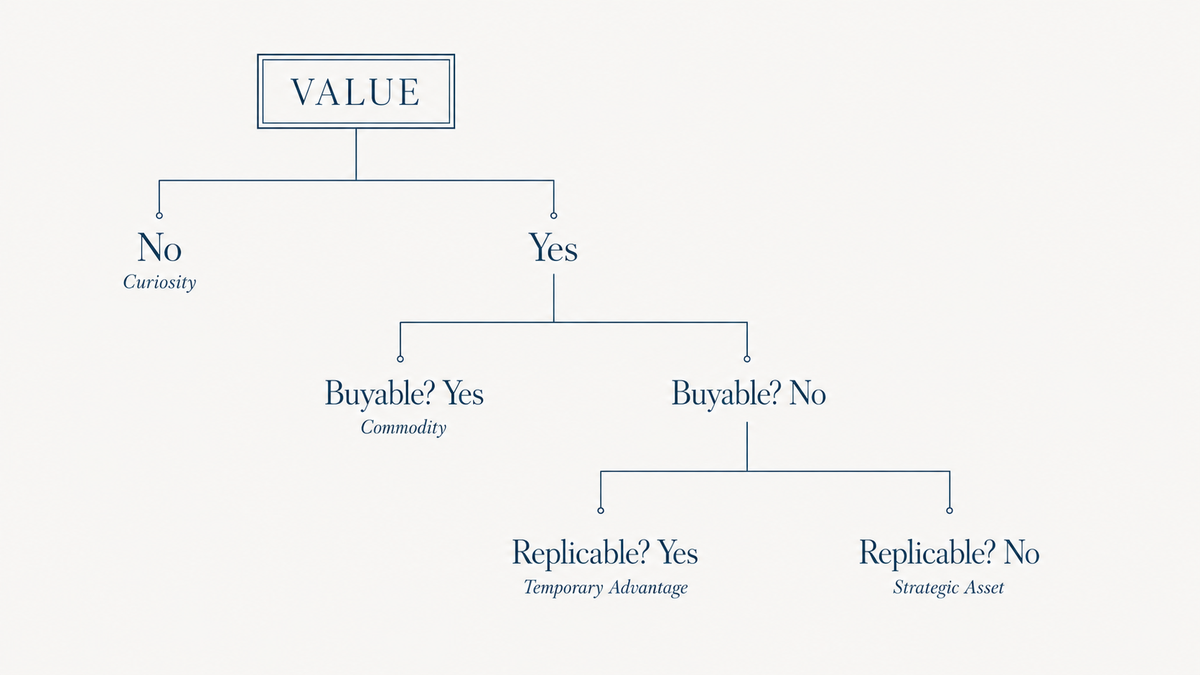
Before asking whether a dataset is complete, accurate, or well-governed, ask three simpler questions:
- Does it improve decisions that affect revenue, cost, or risk?
- Can competitors buy it?
- Can competitors replicate it?
Not everything unique is valuable. But almost every valuable dataset is difficult to obtain.
Only then should quality become the priority.
There is little competitive advantage in becoming the world's foremost curator of facts that everyone else can buy.
Don't start by asking whether your data is clean. Start by asking whether it is yours.