Good Judgement Under Uncertainty

The apprentice tailor learns an odd lesson about judgement: at first, he is barely allowed to use any. The master marks the cloth, chooses the materials, sets the sequence and decides what comes next. At Sassoon, the teacher makes the first cut. At Wagamama, even the tables are numbered the same way. At Oxford, the constraint is different but equally unforgiving: there are more books worth reading than anyone could possibly read before the essay is due.
These settings look very different. Yet they teach the same thing. Good judgement begins with learning which uncertainties deserve your attention.
We often imagine that good decision-makers know more. Often, they don't. What distinguishes them is that they are better at knowing what is worth knowing. The novice is bothered by everything he doesn't know; the expert has learned to be bothered selectively.
Over time, the tailor can look at another maker's garment and read intention in a chalk mark, a crease or the way the buttons have been packed. At Sassoon, the student learns why tension, weight and direction matter—not simply how to reproduce a cut. At Oxford, the student learns to find the “tree trunk” in a reading list of fifty possibilities. In each case, expertise is partly the ability to distinguish signal from surrounding uncertainty.
That makes judgement less an exercise in eliminating uncertainty than in discriminating among unknowns. Which fact do I need? Which assumption could undo me? What can I infer? What can I safely ignore?
The scarce resource is not information. There is usually plenty of that. It is attention.
There is also a point at which good judgement requires something surprisingly difficult: stopping. Another conversation, report, forecast or week of analysis will almost always reveal something more. Oxford makes this especially vivid: another book may improve the essay, but the essay still has to be written. In business, too, information can eventually become a sophisticated form of procrastination.
The aim, then, is not certainty. It is to resolve the decision-critical uncertainties, and knowingly carry the rest. The good decision-maker is not surprised that uncertainty remains; she expected it to.
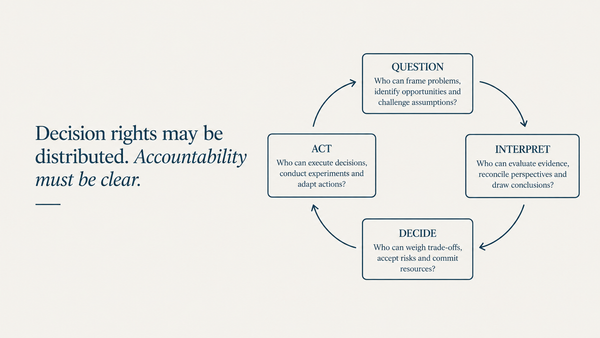
This suggests a different task for organisations. Don't merely teach people answers or give them more information. Teach them where to look, what to question, what to infer, what to ignore—and when they know enough to act.
Before a consequential decision, one question cuts through a remarkable amount of noise:
What don't we know that, if we knew it, could actually change this decision?
Poor judgement tries to know everything. Good judgement knows what needs knowing—and has the nerve to leave the rest unresolved.