AI and the Value of Human Judgement

The most interesting thing about an apprentice tailor is not what they learn, but what gradually disappears.
At first, the master has made the difficult decisions in advance. Chalk marks show where to cut and stitch. Materials are prepared. Work arrives in a deliberate sequence designed to stretch but not overwhelm. When uncertain, the apprentice waits.
Over time, the chalk marks disappear. The apprentice learns not just what to do, but why—and eventually when to do something differently. What replaces the marks is judgement: knowing what matters in this garment, for this client, at this moment—and when the usual rule is the wrong one.
That offers a useful way to think about judgement in an AI-rich world.
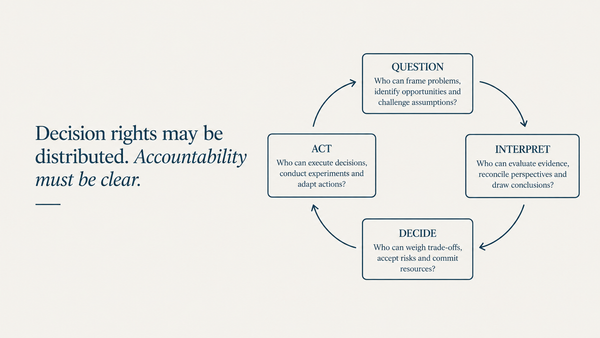
As AI hollows out the middle of judgement, human value migrates to its edges: framing what matters upstream, and choosing—and owning—the consequences downstream.
The middle is becoming abundant: search, synthesis, analysis, conventional options, the statistically probable answer. AI makes much of this thinking cheap.
Oxford is especially revealing. The constraint is not access to knowledge but deciding what deserves attention. A student might face fifty worthwhile sources with time for five. The skill is choosing which five matter—and, just as importantly, which forty-five to ignore.
When knowledge becomes abundant, knowing matters less than knowing what matters.
This is judgement upstream: noticing the anomaly, the weak signal, the question nobody else thought to ask. AI can make answering a question cheap; judgement begins with deciding whether it is the right question.
Downstream, judgement becomes choice. Real decisions rarely optimise one thing. Speed competes with quality; consistency with individuality; today’s benefit with tomorrow’s durability. Someone must decide what to sacrifice, when to depart from precedent, and which risk is worth taking.
Expertise is not simply knowing the rule. It is knowing when the rule applies—and when it should be broken.
Then comes something AI cannot absorb for us: consequence. Someone must own the decision. A tailor cutting precious vicuña cannot press “regenerate.”
Here lies the managerial paradox: AI makes judgement more valuable while making it easier not to develop. If machines increasingly supply the search, synthesis and conventional answer, people lose practice in precisely the capabilities that are becoming scarce.
So the challenge is not simply to keep humans “in the loop.” It is to decide where human judgement must remain in the loop.
Give AI the abundant middle. Keep humans responsible for the edges.
And, like the master tailor, progressively remove the chalk marks. Do not merely ask people to review machine output. Require them to notice, challenge, choose and own.
AI can make answers abundant. It cannot relieve us of deciding what matters—or living with what happens next.